The Science of Signaling
Dopamine & Norepinephrine: The Life of a Nerve Signal
Build it. Store it. Send it. Recover it. Discover the remarkable cycle behind two essential chemical messengers.
Begin reading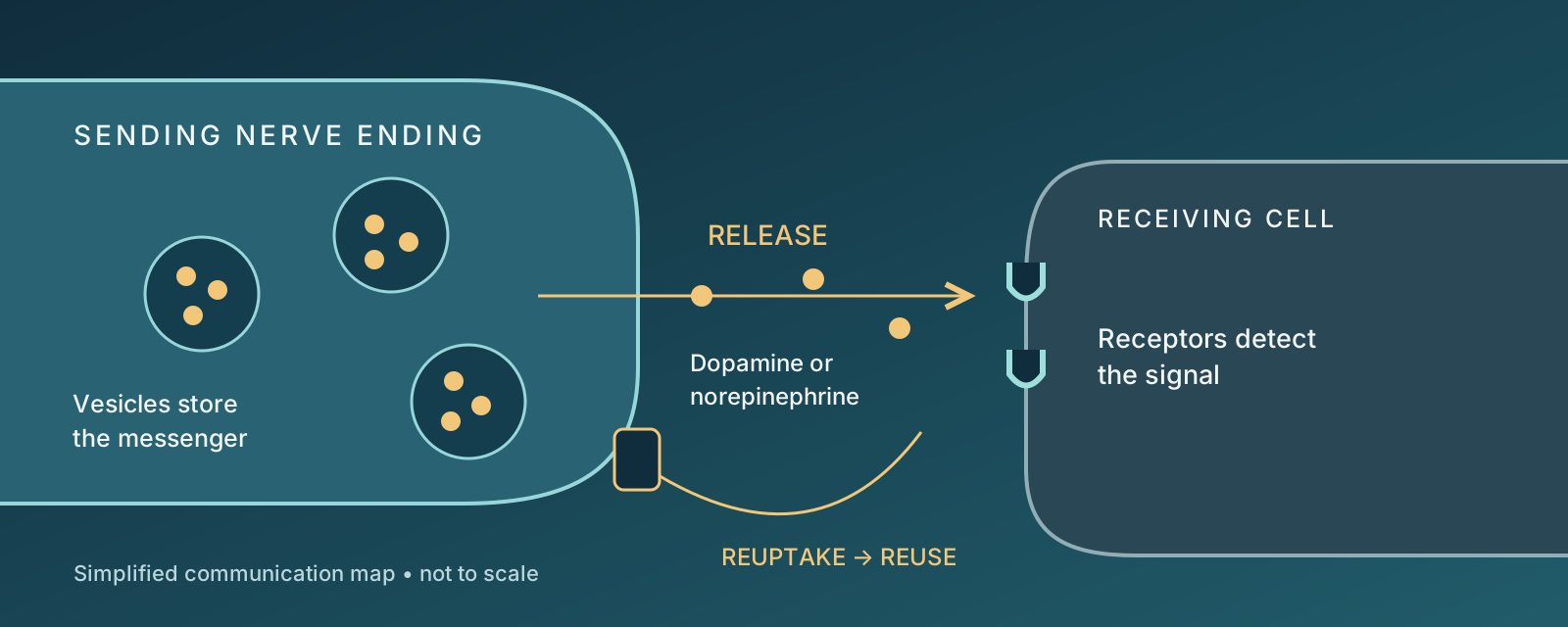
Follow one message
If you arrived here from Glenn's video, this is the next step: slow the process down and follow one message from its building blocks to its return trip. Use the clickable diagram below to explore the route at your own pace.
How does a nerve cell turn a building block from food into a signal that helps you move, pay attention, or respond to the world? Two important messengers in that process are dopamine (DA) and norepinephrine (NE), also called noradrenaline (NA); dopamine helps regulate movement, motivation, and learning, while norepinephrine helps regulate alertness, attention, and parts of the body's automatic stress response. Goldstein and Eisenhofer, catecholamine physiology review
These chemicals belong to a family called catecholamines, and their effect depends on where they are released, which receptors receive them, and how the signal is brought to an end. Goldstein and Eisenhofer Think of this article as a guided tour: you do not need to memorize every chemical name to understand the story, and a full-name reference is waiting at the end.
Choose a messenger. Follow its journey.
Reduced motion is on. Explore every step using the buttons.
Make dopamine in the cytosol
Tyrosine hydroxylase (TH) converts tyrosine (Tyr) to L-3,4-dihydroxyphenylalanine (L-DOPA, or levodopa); aromatic L-amino acid decarboxylase (AADC) then makes dopamine (DA). Catecholamine physiology review
TH uses tetrahydrobiopterin (BH4), ferrous iron (Fe²⁺), and oxygen (O₂); AADC uses pyridoxal 5′-phosphate (PLP), active vitamin B6. Read the physiology
back to cytosol
Schematic, not to scale. All chemical names and the full pathway are explained in the text below. Scientific basis for the diagram
Start with the map
A synapse is a communication site between a nerve cell and another cell; the sending side is called presynaptic, the receiving side is postsynaptic, and the small space between them is the synaptic cleft. Basic Neurochemistry: storage and release Inside the sending nerve ending, the cytosol is the fluid where several chemical reactions happen, while vesicles are tiny membrane-wrapped storage packets. Basic Neurochemistry
Three types of worker keep the system organized: an enzyme changes a molecule, a transporter moves it across a membrane, and a receptor detects a signal and changes cell activity. Goldstein and Eisenhofer The drawings use one sending cell and one receiving cell to make the route clear, although dopamine and norepinephrine can also spread beyond a single synaptic cleft to influence nearby cells. Goldstein and Eisenhofer
From food to a nerve cell
The story begins with phenylalanine (Phe), an amino acid supplied by dietary protein, and tyrosine (Tyr), which comes from food and from the body's conversion of phenylalanine. Phenylketonuria, Nature Reviews Disease Primers The enzyme phenylalanine hydroxylase (PAH) makes that conversion mainly in the liver and also in the kidneys, rather than carrying out the entire process inside every dopamine-producing nerve ending. Phenylketonuria review
PAH uses tetrahydrobiopterin (BH4), ferrous iron (Fe²⁺), and molecular oxygen (O₂) to turn phenylalanine into tyrosine. Phenylketonuria review BH4 is a chemical helper called a cofactor; it is not the name of a B vitamin. The catecholamine system in health and disease
To reach the brain, these amino acids must pass through the blood–brain barrier (BBB), the selective boundary between blood and brain tissue; large neutral amino acid transporter 1 (LAT1) helps carry them across that boundary. Phenylketonuria review Tyrosine must then enter a catecholamine-producing nerve cell, a separate transport step from crossing the barrier. Physiology, Noradrenergic Synapse
The important location change: phenylalanine becomes tyrosine mainly outside the brain; the nerve cell then uses tyrosine to begin making its own catecholamine messenger. Phenylketonuria review, The catecholamine system
Making dopamine
Tyrosine becomes L-DOPA
In the nerve cell's cytosol, tyrosine hydroxylase (TH) converts tyrosine into L-3,4-dihydroxyphenylalanine (L-DOPA), also called levodopa; this reaction uses BH4, ferrous iron, and oxygen. The catecholamine system TH is the pathway's rate-limiting enzyme, meaning this carefully regulated step helps set the pace of catecholamine production. Goldstein and Eisenhofer
L-DOPA becomes dopamine
Next, aromatic L-amino acid decarboxylase (AADC), also known as DOPA decarboxylase (DDC), converts L-DOPA into dopamine. The catecholamine system Its helper is pyridoxal 5′-phosphate (PLP), an active form of vitamin B6. Goldstein and Eisenhofer
Dopamine moves into a storage packet
Newly made dopamine is moved from the cytosol into a vesicle by vesicular monoamine transporter 2 (VMAT2). The ins and outs of vesicular monoamine transporters VMAT2 uses a difference in hydrogen ions, or protons (H⁺), across the vesicle membrane; a vesicular H⁺-adenosine triphosphatase (H⁺-ATPase) creates that difference using adenosine triphosphate (ATP), the cell's energy-carrying molecule. Vesicular monoamine transporters
In a dopaminergic neuron, dopamine is the messenger stored for release. Basic Neurochemistry Packaging separates the stored messenger from the cytosol and helps maintain a supply for future signals. Dopamine and vesicular monoamine transporter review
The norepinephrine branch
A noradrenergic neuron follows the same early steps, but adds another reaction inside its vesicles: dopamine β-hydroxylase (DBH) converts dopamine into norepinephrine. Goldstein and Eisenhofer DBH uses copper, ascorbate (vitamin C), and oxygen, so the storage packet also serves as the site of this final conversion. Goldstein and Eisenhofer
This neuron makes its own dopamine intermediate before turning it into norepinephrine; dopamine does not have to leave a different neuron, cross a synapse, and enter this one first. Basic Neurochemistry The distinction is simple: dopamine is the finished messenger for one kind of nerve cell and a stepping stone to norepinephrine in another. The catecholamine system
Release and reception
When an electrical impulse, called an action potential, reaches the nerve ending, voltage-gated calcium channels (VGCCs) open and allow calcium ions (Ca²⁺) to enter; calcium helps trigger vesicles to fuse with the cell membrane and release their contents through exocytosis. Basic Neurochemistry The cell releases intact dopamine or norepinephrine molecules, rather than breaking them down to get them into the synaptic space. Basic Neurochemistry
Released dopamine can bind dopamine receptors, while norepinephrine can bind alpha and beta adrenergic receptors; the receiving cell's response depends on the receptor and the surrounding circuit. Goldstein and Eisenhofer These messengers are therefore more than simple “pleasure” or “stress” chemicals, with effects that vary across brain and body systems. Goldstein and Eisenhofer
The sending cell also has feedback sensors called autoreceptors: D2 dopamine receptors and alpha-2 (α₂) adrenergic receptors can help reduce further release when the local signal is already strong. Dopamine transporter review, Noradrenergic Synapse Picture them as a built-in volume control, rather than an on/off switch.
Reuptake is not breakdown
Much of the released messenger can be recovered through transporters on the sending cell's outer membrane: the dopamine transporter (DAT) and the norepinephrine transporter (NET). Goldstein and Eisenhofer These transporters use gradients of sodium (Na⁺) and chloride (Cl⁻) to bring messenger molecules back into the cell. Basic Neurochemistry
After reuptake, a molecule can be loaded back into a vesicle by VMAT2 and used again, or it can enter an intracellular breakdown pathway. Goldstein and Eisenhofer That is why reuptake is recovery, not chemical destruction: DAT and NET are return doors, while VMAT2 is the door into the storage packet. Dopamine transporter review
The names are helpful but not absolute rules: NET can also clear dopamine, especially in some brain regions where DAT is less abundant, such as the prefrontal cortex. Dopamine reuptake mechanisms review Diffusion and uptake by surrounding cells also contribute, so the return arrow in the diagram represents an important route, not the only possible destination. Goldstein and Eisenhofer
Two ways to change the molecule
Recovery and reuse are only part of the story: enzymes also change catecholamines into other compounds called metabolites, and some of this processing happens continuously inside cells before any release occurs. Goldstein and Eisenhofer Two names are especially useful to understand.
| System | Full name and plain-language job | Where and with what help? |
|---|---|---|
| MAO-A and MAO-B | Monoamine oxidase A and monoamine oxidase B begin a reaction called oxidative deamination, which changes the amine-containing part of the molecule. MAO structure and mechanism | On the outer membrane of mitochondria inside cells; they use flavin adenine dinucleotide (FAD) and oxygen. MAO review |
| COMT | Catechol-O-methyltransferase adds a small methyl group to the molecule's catechol ring. COMT biochemistry review | Present in several cell types and tissues; it uses S-adenosylmethionine (SAM or SAMe) as the methyl donor and magnesium (Mg²⁺). COMT review |
MAO-A is especially important for norepinephrine metabolism in noradrenergic nerves, but both MAO-A and MAO-B can metabolize dopamine, with their contributions depending on the cell and tissue. Goldstein and Eisenhofer “A handles only norepinephrine; B handles only dopamine” is therefore not an accurate way to divide the work. MAO review
COMT has soluble and membrane-bound forms and is important in cells outside the releasing nerve ending, including supporting brain cells and other tissues. Goldstein and Eisenhofer MAO and COMT should not be pictured as three free-floating cleanup machines in the synaptic cleft; their location, access to the messenger, and order of action matter. Goldstein and Eisenhofer
When the system changes
Physiology explains how a system works; pathophysiology explains what changes when normal function is disrupted. The comparison below highlights different points in the pathway, with arrows showing direction rather than measured concentrations or a personal diagnosis.
Where a change happens matters.
The supply network can change
In Parkinson’s disease, loss of dopamine-producing cells in the substantia nigra disrupts the circuits that coordinate movement. NINDS: Parkinson’s disease
This is a specific neurological disease, not a diagnosis made from a general feeling of low motivation.
Real conditions show why the location of a problem matters: in Parkinson's disease, loss of dopamine-producing neurons in the substantia nigra disrupts movement circuits, contributing to slowed movement and other motor symptoms. National Institute of Neurological Disorders and Stroke: Parkinson's disease That is different from DBH deficiency, a rare disorder in which impaired conversion of dopamine to norepinephrine can cause severe blood-pressure drops on standing. MedlinePlus: DBH deficiency
An earlier problem can occur in phenylketonuria (PKU), where impaired PAH activity allows phenylalanine to accumulate and alters the supply of other large neutral amino acids to the brain. Phenylketonuria review These are specific disease mechanisms, not labels to assign from everyday changes in mood, attention, or energy; diagnosis requires a clinical evaluation.
The breakdown pathways
You can understand the signal without memorizing these routes. For readers who want the chemical detail, the following are important examples rather than a map of every possible reaction.
Dopamine: one route toward HVA
Dopamine → DOPAL → DOPAC → HVA is a major route involving MAO, then aldehyde dehydrogenase, then COMT. Goldstein and Eisenhofer
- DOPAL: 3,4-dihydroxyphenylacetaldehyde, an aldehyde intermediate formed through MAO action. Goldstein and Eisenhofer
- DOPAC: 3,4-dihydroxyphenylacetic acid, produced when aldehyde dehydrogenase (ALDH) processes DOPAL using nicotinamide adenine dinucleotide, oxidized form (NAD⁺). Goldstein and Eisenhofer
- HVA: homovanillic acid, produced when COMT acts on DOPAC. Goldstein and Eisenhofer
COMT can also act first, converting dopamine to 3-methoxytyramine (3-MT), which can then be processed through MAO and ALDH reactions toward HVA. Goldstein and Eisenhofer There is not one compulsory order in which every molecule meets these enzymes. Goldstein and Eisenhofer
Norepinephrine: several steps, several locations
One important route is norepinephrine → DOPEGAL → DHPG → MHPG, involving MAO, aldehyde reductase, and COMT. Goldstein and Eisenhofer
- DOPEGAL: 3,4-dihydroxyphenylglycolaldehyde, the aldehyde formed through MAO action on norepinephrine. Goldstein and Eisenhofer
- DHPG: 3,4-dihydroxyphenylglycol, made by aldehyde reductase (AR) with reduced nicotinamide adenine dinucleotide phosphate (NADPH). Goldstein and Eisenhofer
- MHPG: 3-methoxy-4-hydroxyphenylglycol, produced when COMT acts on DHPG. Goldstein and Eisenhofer
Further processing, especially in the liver, can turn MHPG into vanillylmandelic acid (VMA) through alcohol dehydrogenase (ADH) and ALDH reactions; ADH uses NAD⁺ and zinc. Goldstein and Eisenhofer An alternative branch begins when COMT converts norepinephrine into normetanephrine (NMN), before further metabolism. Goldstein and Eisenhofer
These pathways extend across cells and tissues, not just across the tiny gap of one synapse. Goldstein and Eisenhofer The useful takeaway is that reuptake, repackaging, and chemical breakdown are different jobs that work together.
Your plain-language reference
Use this section as a lookup rather than a memorization list. It covers the abbreviated names used in the article and graphics; ions, energy sources, and reaction ingredients are separated from enzymes because they are not all “cofactors.”
Messengers, building blocks, and metabolites
| Short form | Full name | Role in this article |
|---|---|---|
| Phe | Phenylalanine | Dietary amino acid that can become tyrosine. PAH review |
| Tyr | Tyrosine | Starting amino acid for catecholamine synthesis in the nerve cell. Catecholamine review |
| L-DOPA | L-3,4-dihydroxyphenylalanine; levodopa | Intermediate between tyrosine and dopamine. Catecholamine review |
| DA | Dopamine | Messenger and precursor to norepinephrine. Physiology review |
| NE / NA | Norepinephrine / noradrenaline | Two names for the same messenger. Physiology review |
| DOPAL | 3,4-Dihydroxyphenylacetaldehyde | Dopamine-derived aldehyde intermediate. Metabolism review |
| DOPAC | 3,4-Dihydroxyphenylacetic acid | Dopamine metabolite made from DOPAL. Metabolism review |
| 3-MT | 3-Methoxytyramine | Product of COMT acting on dopamine. Metabolism review |
| HVA | Homovanillic acid | Downstream dopamine metabolite. Metabolism review |
| DOPEGAL | 3,4-Dihydroxyphenylglycolaldehyde | Norepinephrine-derived aldehyde intermediate. Metabolism review |
| DHPG | 3,4-Dihydroxyphenylglycol | Product of AR acting on DOPEGAL. Metabolism review |
| MHPG | 3-Methoxy-4-hydroxyphenylglycol | Product of COMT acting on DHPG. Metabolism review |
| NMN | Normetanephrine | Norepinephrine metabolite; here NMN does not mean the supplement nicotinamide mononucleotide. Metabolism review |
| VMA | Vanillylmandelic acid | Downstream metabolite of norepinephrine and epinephrine; epinephrine is also called adrenaline. Metabolism review |
Enzymes, transporters, and receptors
| Short form | Full name | Plain-language job |
|---|---|---|
| PAH | Phenylalanine hydroxylase | Converts phenylalanine to tyrosine. PAH review |
| TH | Tyrosine hydroxylase | Converts tyrosine to L-DOPA. Catecholamine review |
| AADC / DDC | Aromatic L-amino acid decarboxylase / DOPA decarboxylase | Two names for the enzyme converting L-DOPA to dopamine. Catecholamine review |
| DBH | Dopamine β-hydroxylase | Converts dopamine to norepinephrine inside vesicles. Physiology review |
| MAO-A / MAO-B | Monoamine oxidase A / monoamine oxidase B | Related enzymes involved in monoamine metabolism. MAO review |
| COMT | Catechol-O-methyltransferase | Adds a methyl group to a catechol molecule. COMT review |
| ALDH | Aldehyde dehydrogenase | Converts aldehydes into acids. Metabolism review |
| AR | Aldehyde reductase | Converts an aldehyde into an alcohol, including DOPEGAL to DHPG. Metabolism review |
| ADH | Alcohol dehydrogenase | Helps process MHPG on the route to VMA. Metabolism review |
| LAT1 | Large neutral amino acid transporter 1 | Carries large neutral amino acids across the blood–brain barrier. PAH review |
| VMAT2 | Vesicular monoamine transporter 2 | Loads monoamines into nerve-cell vesicles. VMAT review |
| DAT / NET | Dopamine transporter / norepinephrine transporter | Recover released messengers across the cell membrane. Transporter review, Physiology review |
| H⁺-ATPase | H⁺-adenosine triphosphatase; vesicular proton pump | Uses ATP to build the vesicle's proton gradient. VMAT review |
| VGCC | Voltage-gated calcium channel | Opens with electrical activity, allowing calcium entry. Basic Neurochemistry |
| D2 / α₂ | D2 dopamine receptor / alpha-2 adrenergic receptor | Receptor types that can serve as release-limiting autoreceptors. Transporter review, Noradrenergic Synapse |
Chemical helpers, ions, and energy sources
| Short form or name | Full name | Where it fits |
|---|---|---|
| BH4 | Tetrahydrobiopterin | Cofactor for PAH and TH. Catecholamine review |
| PLP | Pyridoxal 5′-phosphate | Active vitamin B6 cofactor for AADC. Catecholamine review |
| FAD | Flavin adenine dinucleotide | Cofactor used by MAO. MAO review |
| SAM / SAMe | S-adenosylmethionine | Methyl donor for COMT; after donation it becomes S-adenosylhomocysteine (SAH). COMT review |
| SAH | S-adenosylhomocysteine | Product remaining after SAM donates its methyl group. COMT review |
| NAD⁺ | Nicotinamide adenine dinucleotide, oxidized form | Coenzyme used in ALDH and ADH reactions. Metabolism review |
| NADPH | Reduced nicotinamide adenine dinucleotide phosphate | Supplies reducing power for AR. Metabolism review |
| ATP | Adenosine triphosphate | Energy source for the vesicle's proton pump. VMAT review |
| Fe²⁺ | Ferrous iron | Helps PAH and TH function. Catecholamine review |
| Cu; ascorbate | Copper; vitamin C | Helpers used by DBH. Metabolism review |
| Mg²⁺; Zn²⁺ | Magnesium ion; zinc ion | Magnesium supports COMT; zinc supports ADH. COMT review, Metabolism review |
| O₂ | Molecular oxygen | Reaction ingredient for PAH, TH, DBH, and MAO. Catecholamine review, MAO review |
| H⁺; Ca²⁺ | Hydrogen ion/proton; calcium ion | Proton gradient supports vesicle loading; calcium entry triggers release. VMAT review, Basic Neurochemistry |
| Na⁺; Cl⁻ | Sodium ion; chloride ion | Gradients help power reuptake transporters. Basic Neurochemistry |
BBB means blood–brain barrier, and PKU means phenylketonuria. Phenylketonuria review The helpers above explain normal chemistry; their presence in a pathway does not establish a need for an individual supplement or a reason to change treatment.
The idea to remember
Build. Store. Release. Receive. Recover. Reuse or metabolize. That sequence connects the pathway, while different transporters and enzymes control different steps. Goldstein and Eisenhofer Healthy signaling depends on this coordination, not simply on making as much dopamine or norepinephrine as possible. Goldstein and Eisenhofer
Coming in future editions
This foundation will support a closer look at how genes and medications influence chemical signaling. Planned topics include:
- Genetic testing and interpretation: catechol-O-methyltransferase (COMT) and monoamine oxidase (MAO) gene variants, what results can tell us, and the limits of using them to guide care.
- Antidepressant pharmacology: selective serotonin reuptake inhibitors (SSRIs), tricyclic antidepressants (TCAs), and monoamine oxidase inhibitors (MAOIs), with a clear distinction between serotonin pathways and the dopamine/norepinephrine pathways introduced here.
- Dopamine-modulating medicines: where different medicines act along a signaling pathway, and why their effects cannot be reduced to simply “more” or “less” dopamine.
- Stimulants and related substances: the mechanisms and risks of cocaine, amphetamines, and 3,4-methylenedioxymethamphetamine (MDMA), explained as education rather than instructions for use.
Each edition will separate the underlying mechanism from the evidence for clinical decisions. The goal is to make informed conversations with licensed medical providers easier, not to turn a single genetic result into a diagnosis or treatment plan.
Bring the science into context
Bring questions about persistent changes in attention, movement, mood, or energy to licensed medical providers. An individualized conversation can place symptoms, medications, nutrition, and relevant testing in context without reducing your health to one molecule.
Visit IFP.life to learn about becoming a patient. This article is educational and does not diagnose a condition or recommend starting, stopping, or adjusting a medication or supplement.