Testosterone for Women: The Benefits, the Evidence and the 2026 Label Changes
· 15 min read
Articles about functional medicine approaches to health and wellness.
View All TagsVitamin D helps your body absorb calcium and maintain strong, properly mineralized bones. It also contributes to normal muscle, nerve, and immune function, making adequate vitamin D an important part of health. NIH ODS: Vitamin D
When there is a clinical reason to evaluate vitamin D, a blood test can help identify a deficiency and inform an individualized treatment discussion. The key is interpreting the result in context, rather than treating a supplement label or a laboratory number as a complete care plan. NIH ODS: Vitamin D
The short version: This guide focuses on lab values, not a universal daily dose. The goal is to understand your result, explore whether genetics or other health factors matter, and agree on an individualized plan with your licensed medical provider.
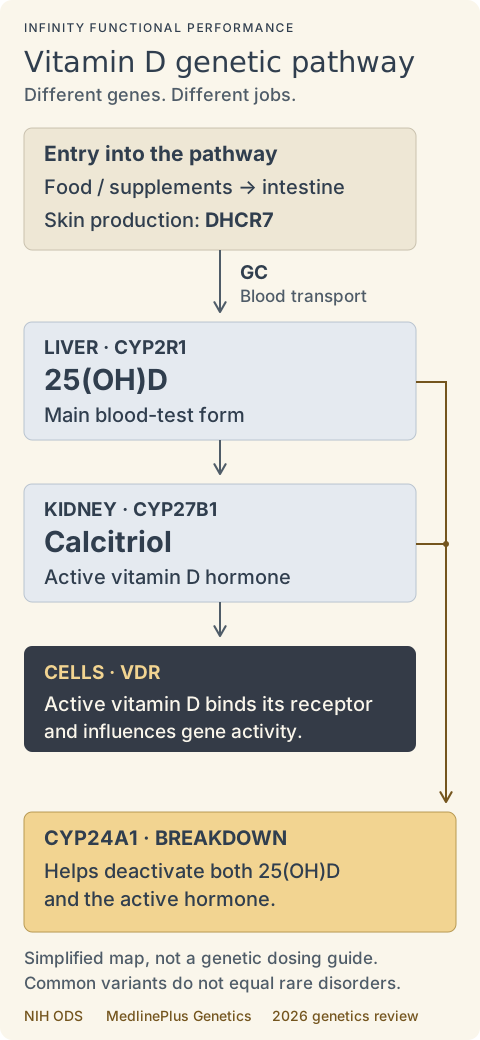
Your skin can make vitamin D after ultraviolet-B exposure, and foods or supplements can also supply it. NIH ODS: Vitamin D The liver converts it into 25-hydroxyvitamin D, written as 25(OH)D, and the kidneys perform much of the next conversion into its active hormone form. NIH ODS: Vitamin D
The usual test for vitamin D status is serum total 25-hydroxyvitamin D. NIH ODS: Vitamin D The active-form test, 1,25-dihydroxyvitamin D, answers different clinical questions and is generally not a good test of vitamin D stores because its level is tightly regulated and can remain normal until deficiency is severe. NIH ODS: Vitamin D
Genetic differences can help explain why two people do not reach the same vitamin D level on a similar routine. Studies have linked variants in vitamin D pathway genes with differences in baseline levels and the response to supplementation, although the effects of common variants are often modest and vary between studies. Randomized-trial genetic analysis 2026 genetics review
However, absorption is only one step: moving vitamin D from the intestine into the body is different from carrying it through the blood, activating it, responding to it, or breaking it down. Genetic pathways review A low blood result does not, by itself, identify which step is responsible. NIH ODS: Vitamin D
In a small study of 39 healthy men, researchers linked a combination of genetic variants to differences in vitamin D bioavailability after a test meal. INRAE research summary This supports further research into absorption differences, but it does not establish a routine genetic test that can reliably select a person's supplement dose. Genetic pathways review
Yes, but the useful question is what the result would change. Clinical laboratories offer targeted testing and gene panels that include genes such as CYP2R1, CYP27B1, and VDR, using specimens such as blood or saliva; coverage depends on the panel selected. University of Chicago Genetic Services
There are two different kinds of information to keep separate:
Rare inherited disease becomes more relevant when there is childhood-onset rickets, a suggestive family history, an unusual calcium/phosphate pattern, or persistent disease despite appropriate treatment. MedlinePlus Genetics Rickets treatment guidance Recurrent kidney stones together with unexplained high calcium and suppressed parathyroid hormone can point toward a different problem, including impaired vitamin D breakdown. CYP24A1 clinical report
For an unexpectedly low result, the evaluation should also consider supplement use, absorption conditions, medications, and kidney or liver health rather than assuming genetics is the explanation. NIH ODS: Vitamin D Depending on the findings, a specialist may add calcium, phosphate, parathyroid hormone, kidney-function or urine testing, and selected vitamin D metabolites before choosing genetic testing. Rickets treatment guidance CYP24A1 clinical report
Ask whether a reported finding is common, disease-causing, or a variant of uncertain significance, meaning its effect is not established. Uncertain variants require careful interpretation alongside the clinical findings and should not be treated as a confirmed diagnosis. CYP24A1 clinical report
Treatment addresses the affected step, not simply the name of a gene. The examples below concern diagnosed rare disorders, not ordinary SNP findings on a wellness report. MedlinePlus Genetics Rickets treatment guidance
Calcifediol, calcitriol, and ordinary vitamin D3 are not interchangeable products with interchangeable doses. Treatment of inherited vitamin D disorders requires monitoring that can include blood calcium, phosphate, PTH, kidney function, and urine calcium, rather than following 25(OH)D alone. Rickets treatment guidance
For a common genetic variant without a diagnosed inherited disorder, the practical approach remains interpreting the clinical picture and measured response. Genotype-based supplement formulas are still being studied and should not be presented as established treatment algorithms. 2026 genetics review
Vitamin D's active form is itself a hormone, and its relationships with other hormones are not all the same. Its calcium-regulating actions are well established; findings involving reproductive, metabolic, and thyroid outcomes are more dependent on the population and outcome studied. Endotext: Calcium and phosphate homeostasis Endocrine Society guideline 2026 testosterone review
Parathyroid hormone, or PTH, helps keep blood calcium in balance: when calcium falls, PTH rises and stimulates production of active vitamin D, which helps the intestine absorb calcium. Endotext Active vitamin D also helps restrain PTH production, while another hormone, FGF23, helps regulate phosphate and reduces active vitamin D production. Endotext
This feedback system explains why a vitamin D result sometimes needs to be read alongside calcium and PTH rather than in isolation. An abnormal PTH result can have several causes, so it should not automatically be attributed to vitamin D deficiency. Endotext
Vitamin D participates in processes related to insulin secretion and glucose metabolism. NIH ODS: Vitamin D For adults with high-risk prediabetes, the Endocrine Society suggests supplementation in addition to lifestyle measures to reduce progression to diabetes; this is a targeted recommendation, not proof that more vitamin D improves insulin function in everyone. Endocrine Society guideline
That recommendation does not establish a universal 25(OH)D target or a genetic dosing formula. It also does not replace nutrition, physical activity, or other indicated diabetes care. Endocrine Society guideline
Testosterone findings are mixed: a 2024 review found an increase in total testosterone but not free testosterone, while a 2026 review found no clear, reproducible effect on total testosterone or androgen-availability measures. 2024 testosterone review 2026 testosterone review Correcting a vitamin D deficiency may be appropriate for its own reasons, but these findings do not establish vitamin D as a reliable testosterone-raising treatment. 2026 testosterone review
The direction of a hormone change can also depend on the condition: in women with polycystic ovary syndrome, a 2023 analysis found that supplementation reduced total testosterone, with no significant improvement in the reported hair-growth score or sex hormone-binding globulin. PCOS trial review Those findings do not establish that vitamin D predictably raises estrogen or progesterone, restores fertility, or “balances hormones” in women generally. PCOS trial review
Vitamin D's immune effects have prompted research in Hashimoto's thyroiditis, but study results are inconsistent. Some trials report lower thyroid antibodies, while a 2024 network meta-analysis did not find a significant vitamin-D-only antibody benefit in its six-month analysis. Hashimoto's supplement review
Changes in antibody levels are not the same outcome as improved thyroid hormone production, symptoms, or reduced medication needs. This evidence does not establish vitamin D as a replacement for thyroid hormone treatment, so thyroid care and any vitamin D deficiency should be evaluated on their own merits. Hashimoto's supplement review
Food and supplements are inputs; your blood result helps show your vitamin D status. NIH ODS: Vitamin D Absorption problems, prior gastric bypass, body size, and other health factors can affect that status, which is why the same supplement routine does not necessarily produce the same result in everyone. NIH ODS: Vitamin D
Fatty fish, fortified milk or plant beverages, and selected fortified cereals can contribute vitamin D; eggs and mushrooms provide smaller or variable amounts. NIH ODS: Vitamin D If a supplement is part of your care plan, taking it with a meal containing some fat can improve absorption, although absorption also occurs without dietary fat. NIH ODS: Vitamin D
Bring a complete list or photographs of your supplement labels to your visit. Include multivitamins, drops, calcium combinations, and stand-alone vitamin D so your provider can review the entire routine.

Testing is most useful when the result will help answer a clinical question. Situations such as low blood calcium, malabsorption, or a suspected deficiency may warrant evaluation; routine screening of generally healthy adults is a different question and is not recommended by the Endocrine Society's 2024 disease-prevention guideline. Endocrine Society: Vitamin D disease-prevention guideline (2024)
Laboratories may report 25(OH)D in ng/mL or nmol/L: multiply ng/mL by 2.5 to obtain nmol/L. NIH ODS: Vitamin D For example, 80 ng/mL equals 200 nmol/L, whereas 80 nmol/L equals 32 ng/mL, so the units cannot be left out of a target or treatment discussion. NIH ODS: Vitamin D
The following ranges summarize the National Academies' interpretation reported by NIH; they are not a personalized prescription or a guarantee of outcomes. NIH ODS: Vitamin D
| Serum 25(OH)D | General interpretation |
|---|---|
| Below 12 ng/mL | Associated with vitamin D deficiency and risk of impaired bone mineralization. NIH ODS |
| 12 to below 20 ng/mL | Generally considered inadequate for bone and overall health in healthy people. NIH ODS |
| At least 20 ng/mL | Generally considered adequate for most healthy people; this is not permission to raise the level without an upper boundary. NIH ODS |
| Above 50 ng/mL | Linked to potential adverse effects, particularly above 60 ng/mL. NIH ODS |
80 ng/mL is not an established minimum for routine care or disease prevention. The Endocrine Society has not identified blood levels that provide outcome-specific prevention benefits in clinical trials, and NIH summarizes guidance to avoid levels above approximately 50–60 ng/mL. Endocrine Society guideline NIH ODS: Vitamin D
A result of 80 ng/mL does not, by itself, prove vitamin D toxicity; classic supplement-related toxicity usually involves much higher levels together with excess calcium. NIH ODS: Vitamin D However, being below a typical toxicity threshold does not establish a benefit or make that level an appropriate minimum to maintain. NIH ODS: Vitamin D If your result is around 80 ng/mL or higher, review it with your licensed medical provider rather than increasing supplements to maintain or exceed it.
Vitamin D assays can differ between laboratories and methods, which can affect interpretation of an apparent change. NIH ODS: Vitamin D Bring prior results, their units, and your current supplement list, and ask whether a repeat result would meaningfully change care.
Correcting a deficiency supports normal calcium handling and bone mineralization. NIH ODS: Vitamin D People with fat-malabsorption conditions or prior gastric bypass may need particular attention because their ability to absorb vitamin D can be reduced. NIH ODS: Vitamin D
An individualized conversation can address four practical questions:
Some supplementation recommendations do not require a baseline test. The 2024 guideline suggests supplementation for selected groups, including adults 75 and older, pregnancy, and high-risk prediabetes, for specific potential benefits; those recommendations do not establish a target of 80 ng/mL or routine testing for everyone in those groups. Endocrine Society: Vitamin D disease-prevention guideline (2024)
Both vitamin D2 and D3 can raise blood levels, with D3 generally raising them more and maintaining them longer. NIH ODS: Vitamin D Ask your provider which preparation fits the reason for treatment and how your response will be assessed.
Magnesium contributes to bone health and affects active vitamin D and parathyroid hormone, while vitamin K helps proteins involved in bone metabolism function normally. NIH ODS: Magnesium NIH ODS: Vitamin K Whether additional supplements are useful is a separate discussion from choosing a vitamin D target.
Vitamin K can interact seriously with warfarin, and impaired kidney function increases the risk of magnesium toxicity. NIH ODS: Vitamin K NIH ODS: Magnesium Include combination products in the medication and supplement review.
Excess vitamin D from supplements can raise blood and urine calcium, with possible kidney injury and other complications. NIH ODS: Vitamin D Thiazide diuretics can increase the risk of high calcium when combined with vitamin D, particularly in people with impaired kidney function or hyperparathyroidism. NIH ODS: Vitamin D
Warning symptoms can include nausea, vomiting, unusual thirst, frequent urination, weakness, and confusion. NIH ODS: Vitamin D Seek prompt medical evaluation if these develop while taking substantial vitamin D supplements, and seek urgent care for severe symptoms.
Ask your provider whether your result or symptoms call for checking calcium and kidney function. A lab-guided plan should include an upper boundary and a reason for follow-up, not just a minimum number to exceed.
Skin production varies with season, age, skin pigmentation, clothing, and other factors, so time outdoors cannot reliably predict a blood level. NIH ODS: Vitamin D Ultraviolet exposure also raises skin-cancer risk, making deliberate unprotected exposure an unsuitable prescription for reaching a laboratory target. NIH ODS: Vitamin D
The practical next step is a conversation about your health history, existing results, and whether testing or treatment would change your care. Use that discussion to build a plan you understand and can follow.
The bottom line: Vitamin D care is about supporting health, not maximizing a test result. Bring your lab report, previous results, medications, and supplement labels to a conversation with licensed medical providers.
Infinity Functional Performance can help you explore whether an individualized evaluation is appropriate. Ask what your result means, whether a genetic test would change care, how other hormone findings fit the picture, and what follow-up would be useful; no particular test, treatment, or outcome is promised.
Visit ifp.life, call 972-619-5350, or email info@ifp.life to learn about becoming a patient.
Educational content only. This article is not a diagnosis, prescription, or substitute for individual medical advice. Do not start, stop, or adjust treatment based on a blog.
A plain-language guide to sleep, recovery, and the daily habits discussed in IFP’s nighttime hormone protocol.
Infinity Functional Performance | Patient & Athlete Education Series
Every training program, every nutrition plan, and every recovery protocol makes assumptions about one thing: your metabolism. How many calories you burn at rest. What fuel — fat or carbohydrate — you rely on. How efficiently your heart, lungs, and cells move oxygen. Where your true "fat‑burning" heart‑rate lives, and where anaerobic stress begins.
Most gyms and clinics estimate those numbers using population equations such as Harris‑Benedict or Mifflin‑St Jeor. Those equations are useful, but they carry meaningful error at the individual level — group‑level accuracy is only around 60–80%, and individual predictions frequently miss measured resting metabolic rate by ≥10%, sometimes by hundreds of calories per day (Frankenfield et al., 2005 — J Am Diet Assoc; Achamrah et al., 2016 — J Acad Nutr Diet). A 300 kcal/day error is the difference between weight loss and a stubborn plateau — or between healthy fueling and unintended under‑eating.
At Infinity Functional Performance we replace estimation with measurement. Our platform is PNOĒ, a portable breath‑by‑breath metabolic analyzer that has been validated head‑to‑head against the laboratory gold‑standard COSMED Quark CPET, with near‑perfect agreement (r ≈ 0.98 for VO₂, VCO₂, and ventilation, and test‑retest reliability ICC ≈ 0.98) (Tsekouras et al., 2019 — Front Sports Act Living).
We offer two tests:
Together, these two tests build what we call a Metabolic Blueprint — an individualized map for training, nutrition, and recovery. Here's what each one delivers.